Human Factors Midterm & Final Projects
Throughout my time in the human factors program at Tufts, I have been challenged in a multitude of ways to complete human factors projects on a short timeline. Many of these projects take the form of large midterm or final exams for my classes. Below is a selection of the projects I’m most proud of - showcasing work that doesn’t fall under its own dedicated page.
. Ergonomics in Design
. Ergonomics in Design

Professor Nick Katis | Fall, 2024
This was a two-week, three-person group project where we needed to compare the design and dimensions three brands of a household product with each other. This project had the following objectives:
Pick a product (computer mouse) and find three brands
Decide which body dimensions correlate to usage (hand measurements)
Find public datasets with related body measurements & percentiles
Analyze each mouse’s features’ intended designs
Measure each mouse’s relevant dimensions and compare to relevant human body measurement percentiles (5th percentile female and 95th percentile male)
Compare the three brands
Comparison of Ergonomics of Household Product Brands
. Human-Machine System Design
. Human-Machine System Design

Professor Dan Hannon | Fall, 2023
This cumulative project involved choosing a human-machine system that I experienced in my life and then apply three analytical perspectives to it from class. I chose to analyze my Apple Watch, and the project included the following components:
Workflow & Task Analysis
Workflow diagram
Task analysis
Observations and recommendations
Automation
System constraints
Task allocation
Automation levels
Trust and arbitration
Signal Detection Theory
Semester Project

This exam was a week-long individual project that involved choosing an expert, analyzing their task, introducing automation, and then re-analyzing the task. I chose the artist Ashley Gibson, who crafts “Mushling” dolls by hand. The project included the following:
Interviewing the expert to analyze their task
Creating a pre-automation workflow diagram
Creating a post-automation task analysis diagram
Creating a post-automation workflow diagram
Completing a human-machine system breakdown
Creating a human-machine system diagram
Analyzing and graphing automation levels and stages
Analyzing and documenting trust between entities, autonomy, and arbitration
Midterm Exam 1

This exam was a week-long, open-book, open-notes exam with questions related to the following concepts:
Fitts’ Law
Information Theory
Hick Hyman Law
Signal Detection Theory
For a complete list of exam questions, click here.
Midterm Exam 2

This exam was a week-long individual project that involved answering several questions about the class’s contents. The project included the following:
Cognitive load, including intrinsic, extrinsic, and germane loads
Instructional support needs and design changes
Workload and human performance, including metrics and measurements
Challenges for automation
An analysis of an in-class smart motor activity including workflow, cognitive load, signal detection theory, trust in automation, human-machine task allocation
Information theory
Final Exam
. Consumer Psychology
. Consumer Psychology

Professor James Intriligator | Spring, 2024
This project was the first portion of a consumer psychology project, requiring me to find a poster “in the wild” and analyze it from a consumer psychology perspective. I found a poster in a jetbridge that advertised IHG Hotels & Resorts. From there, I analyzed its:
Goals
Demographics
Psychographics
Design features (font, color, composition)
Contents
Placement
Data that could be collected about the poster & how
You can view the presentation here.
Product & Packaging Analysis
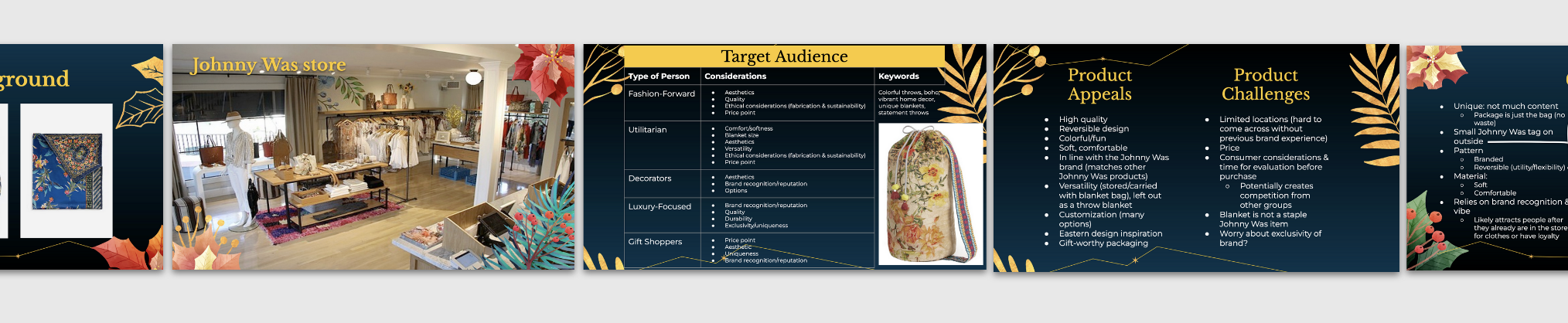
After analyzing the poster, we were asked to select a product from our lives and analyze its packaging. I chose a Johnny Was blanket due to its unique no-waste bag. My presentation on the blanket included the following:
Product and packaging description
Product background
Product location & store
Consumer profile including demographics and psychographics
Product appeals and challenges
Recommendations for improvements
Data that could be collected about the product and how
Storyboard
You can view the presentation here.
Poster Analysis
Poster vs. Product & Packaging Analysis
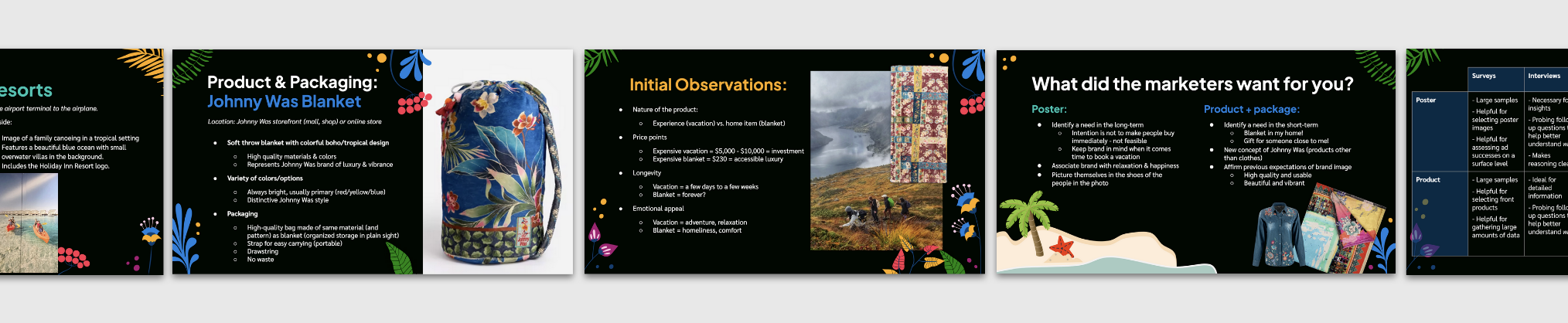
Projects 1 and 2, the poster and product/packaging, led into project 3: a comparison presentation of the two. In this presentation, I analyzed the following for both items:
Initial observations
Intended vs. true audiences
Intended impressions & approaches to achieving impressions
Similarities and differences in potential data collection and methodology
You can view the presentation here.
. Methods for Human Factors Engineering
. Methods for Human Factors Engineering

Professor Dan Hannon | Spring, 2022
This exam was a week-long individual project that involved creating hypothetical exam questions for a series of topics covered in class and then answering them. Topics covered on the exam included the following:
Knowledge elicitation
Anthropometry
Biomechanics
Heuristic review
Mental workload
Error analysis
User testing
Mental models
Final Exam
. Applied Behavioral Statistics
. Applied Behavioral Statistics

Professor Daniel Hannon | Fall, 2023
This exam was a week-long project that involved choosing an empirical article to analyze from a statistical perspective. Using my knowledge of R from the class, I needed to complete the following objectives:
Choose an article with a robust data set and analysis
Characterize the data and consider its validity and how easily it can be cleaned in R
Decide if the authors make their case statistically
Describe the within or between-subjects design and how challenging it would be to switch
Consider how to modify the analysis to include an ANOVA and linear regression, as well as how we would interpret the results
Describe one other lasting concept I learned
Final Exam

This final project was a week-long project that involved running a “small-n experiment,” or an experiment with a very small number of participants, and then using R to conduct a statistical analysis to either accept or reject the null hypothesis. My chosen experiment involved two conditions; one where the participants typed as fast as they could on a typing test alone, and one where the participants typed as fast as they could while competing with a researcher. The project included the following components:
Choose a study and create an experimental procedure
Conduct the study
Export the data and clean it if necessary
Use R to analyze the .csv file
Accept or reject the null hypothesis (competition makes people type faster than individually) and then describe why
Final Project